
























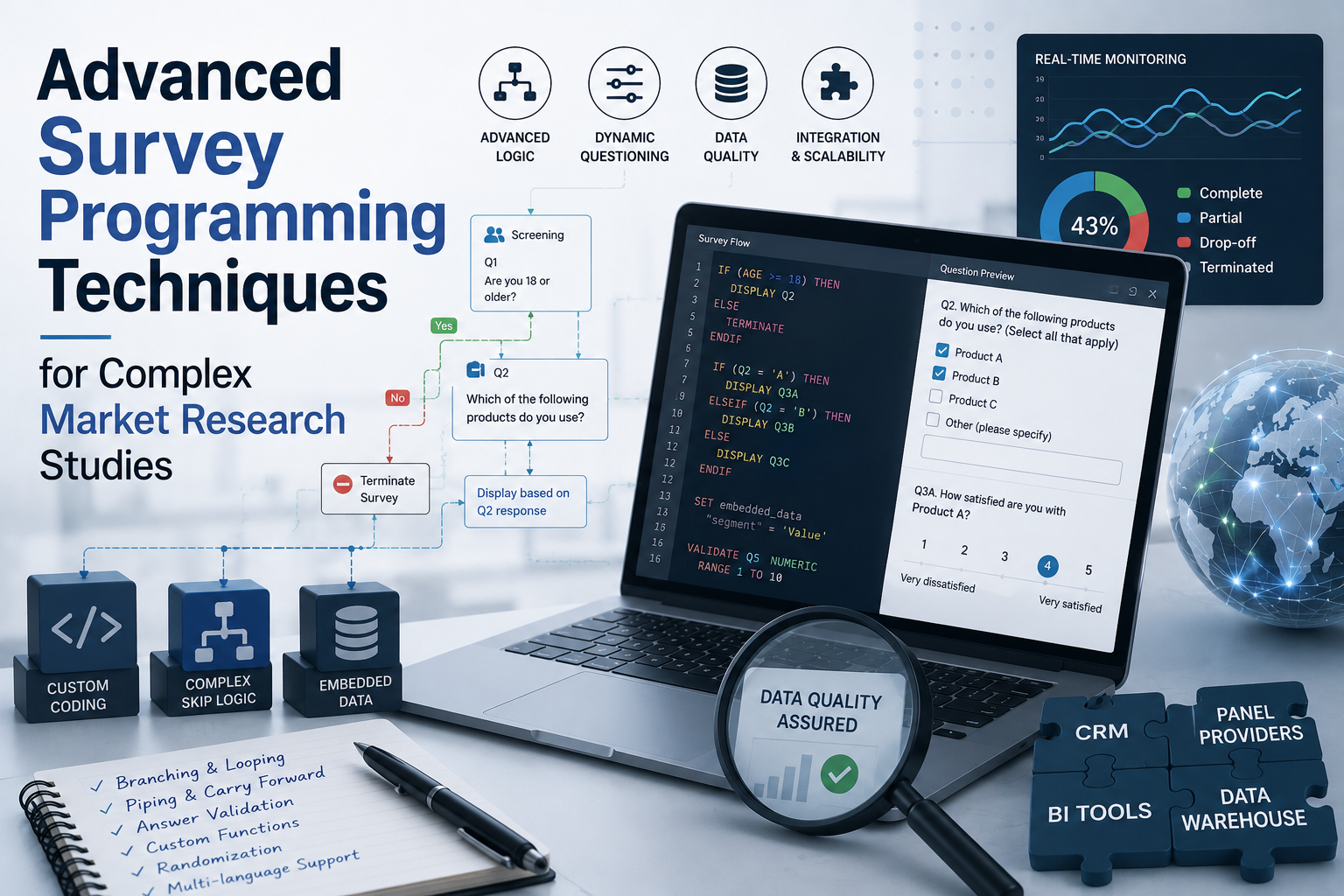
Modern market research has evolved far beyond simple questionnaires and basic customer feedback forms. Organizations today rely on sophisticated research methodologies to understand consumer behavior, evaluate market opportunities, test product concepts, measure brand perception, and support strategic decision-making. As research objectives become more complex, survey programming must also advance to accommodate intricate study designs, dynamic respondent experiences, and rigorous data quality requirements.
Many researchers underestimate the role survey programming plays in the success of a market research project. While questionnaire design often receives significant attention, the way that questionnaire is programmed can ultimately determine whether a study generates accurate, reliable, and actionable insights. Even the most carefully crafted survey questions can produce poor results if the survey logic, routing, validation, and quality controls are not implemented correctly.
Advanced survey programming techniques allow researchers to manage complex respondent pathways, personalize survey experiences, automate data validation, support sophisticated research methodologies, and improve overall data quality. These capabilities are particularly important in large-scale market research studies where even minor programming errors can lead to significant data inaccuracies and costly project delays.
This guide explores the advanced survey programming techniques used by professional survey programmers to support complex market research studies and ensure high-quality research outcomes.
Why Advanced Survey Programming Matters
The complexity of market research projects continues to increase. Organizations frequently conduct studies involving multiple target audiences, extensive segmentation criteria, adaptive questionnaires, and advanced analytical methodologies. Traditional survey programming approaches often struggle to support these requirements effectively.
Advanced survey programming provides the flexibility needed to manage these challenges while maintaining data integrity and respondent engagement.
Professional survey programmers focus on creating survey experiences that feel seamless to participants while simultaneously ensuring that researchers collect accurate and complete data. This balance between respondent experience and data quality is one of the defining characteristics of successful survey programming.
Organizations that invest in advanced programming techniques often experience higher completion rates, lower dropout rates, better respondent engagement, improved data quality, and more reliable research findings.
Complex Survey Logic: The Foundation of Advanced Programming
Survey logic determines how respondents move through a questionnaire. In simple surveys, respondents may answer questions in a linear sequence. However, complex market research studies often require multiple pathways that adapt based on individual responses.
Advanced survey logic allows surveys to become more intelligent and responsive. Rather than presenting every respondent with the same questions, the survey dynamically adjusts based on demographics, purchasing behavior, product usage, previous responses, and qualification criteria.
For example, a consumer electronics company conducting product research may need to show entirely different sections to smartphone users, tablet users, and laptop users. Within those groups, additional branching may occur based on brand preference, purchase history, or usage frequency.
Without sophisticated survey logic, respondents would be forced to answer irrelevant questions, increasing survey fatigue and reducing data quality. Advanced survey logic ensures that every participant receives a tailored experience that aligns with their specific characteristics and responses.
Nested Branching and Multi-Level Routing
One of the most powerful survey programming techniques involves nested branching. Nested branching occurs when multiple layers of logic determine the respondent's path through a survey. Instead of relying on a single condition, the survey evaluates several conditions simultaneously before determining which questions should appear.
Consider a healthcare research study targeting physicians. The survey may first identify the physician's specialty, then evaluate years of experience, patient volume, and treatment preferences before directing respondents to highly relevant question sets. This approach allows researchers to collect detailed information while minimizing unnecessary questions.
Multi-level routing is particularly valuable in:
- Healthcare research
- B2B market research
- Financial services studies
- Customer journey research
- Product usage and attitude studies
When implemented correctly, nested branching creates highly personalized survey experiences that improve both respondent engagement and data quality.
Dynamic Question Display and Real-Time Personalization
Respondents expect personalized digital experiences. Advanced survey programming enables surveys to adapt in real time based on participant responses.
Dynamic question display allows specific content to appear or disappear automatically based on predefined conditions. This functionality creates a more relevant and engaging experience while reducing survey length.
For example, if a respondent indicates that they recently purchased a specific product, the survey can automatically display follow-up questions related to that product category while hiding unrelated sections.
Real-time personalization can also incorporate:
- Respondent names
- Previous answers
- Product selections
- Brand preferences
- Geographic information and purchase history
These techniques make surveys feel more conversational and less repetitive, increasing completion rates and improving response quality.
Advanced Piping and Carry-Forward Techniques
Piping is one of the most valuable tools in advanced survey programming. It allows information entered by respondents earlier in the survey to be automatically inserted into later questions. This creates continuity throughout the survey and reduces repetitive questioning.
For example, if a respondent identifies three preferred brands at the beginning of a survey, those brands can automatically appear in subsequent rating, ranking, and comparison questions. Carry-forward functionality extends this concept further by transferring selected responses into future question sets.
Researchers frequently use carry-forward techniques for:
- Product evaluations
- Brand comparisons
- Customer experience studies
- Employee feedback surveys
- Healthcare research
These capabilities improve survey efficiency while providing richer and more personalized data collection experiences.
Advanced Randomization Techniques
Survey bias remains a major concern in market research. Respondents often exhibit order bias, meaning their answers can be influenced by the sequence in which options are presented. Advanced randomization techniques help reduce this risk.
Professional survey programmers implement randomization at multiple levels, including:
- Answer choices
- Question blocks
- Brand lists
- Product concepts and attribute sets
Randomization ensures that responses reflect genuine opinions rather than positional influences. In concept testing studies, for example, randomizing concept presentation helps eliminate bias caused by one concept consistently appearing first. The result is more reliable and statistically valid research data.
Quota Management and Sample Control
Complex market research studies often require specific respondent distributions. Researchers may need equal gender representation, regional quotas, industry-specific quotas, age-group quotas, or customer segment quotas.
Advanced survey programming supports real-time quota management. As respondents complete surveys, the system continuously monitors quota fulfillment and automatically redirects or terminates participants when specific quotas are reached.
Effective quota management ensures that research samples accurately represent target populations and support valid analytical conclusions.
Conjoint and Choice Modeling Survey Programming
Conjoint analysis has become one of the most widely used methodologies for understanding consumer preferences. Unlike traditional surveys, conjoint studies require sophisticated programming to present respondents with dynamically generated product combinations and choice scenarios.
Advanced survey programmers must ensure that attributes are balanced correctly, randomization functions properly, choice tasks remain statistically valid, and survey performance remains optimized. Poor programming can compromise the validity of conjoint studies and lead to inaccurate preference models.
Data Validation Beyond Basic Checks
Many organizations rely on simple validation rules such as mandatory responses or numeric range restrictions. While useful, these controls represent only the beginning of effective data validation. Advanced validation techniques examine response consistency across multiple questions and identify potential quality concerns.
Examples include identifying:
- Contradictory responses
- Unrealistic selections
- Speeding behavior
- Straight-lining patterns
- Duplicate entries
These automated checks help researchers identify low-quality responses before they affect analytical results, contributing directly to higher data accuracy and more trustworthy business insights.
Mobile-First Survey Programming
Mobile devices now account for a significant percentage of survey participation worldwide. Advanced survey programming must prioritize mobile usability from the earliest stages of development.
Mobile-first design considerations include:
- Responsive layouts
- Touch-friendly interfaces
- Optimized question formats
- Reduced scrolling requirements and faster loading times
Poor mobile experiences often result in survey abandonment and lower completion rates. Professional survey programmers continuously test surveys across multiple device configurations to ensure consistent performance and user experience.
Quality Assurance in Advanced Survey Programming
Even the most sophisticated survey logic can fail if proper testing procedures are not followed. Quality assurance represents a critical component of advanced survey programming.
Professional QA processes typically include:
- Logic and branch testing
- Validation testing
- Quota verification
- Mobile and browser compatibility testing
- Data output structure verification
Comprehensive testing helps identify programming issues before respondents enter the live survey, drastically reducing costly corrections during active fieldwork.
Common Challenges in Complex Survey Programming
Complex studies introduce unique challenges that require specialized technical expertise. Researchers frequently encounter obstacles such as excessive survey length, complex routing requirements, massive respondent segments, multilingual deployments, data integration challenges, and performance optimization concerns.
Advanced survey programming techniques help teams systematically overcome these obstacles while maintaining stellar data quality and respondent satisfaction.
The Future of Advanced Survey Programming
Artificial intelligence, automation, and adaptive research technologies are rapidly transforming survey programming. Future survey environments will increasingly incorporate:
- AI-assisted questionnaire optimization
- Intelligent automated respondent routing
- Automated real-time data quality control and validation
- Adaptive, predictive survey experiences and engagement models
Organizations that embrace these innovations will be better positioned to collect high-quality research data and generate highly actionable insights.
A Foundational Component of Modern Market Research
Advanced survey programming has become an essential component of modern market research. As research methodologies grow more sophisticated, organizations require programming techniques that support complex logic, personalized experiences, advanced validation, and rigorous quality control.
From nested branching and dynamic question display to conjoint programming and quota management, advanced survey programming techniques enable researchers to collect higher-quality data while simultaneously improving respondent engagement.
Organizations that invest in professional survey programming expertise gain significant advantages in data accuracy, research efficiency, and decision-making confidence. In today's competitive research landscape, advanced survey programming is no longer a technical enhancement — it is a strategic requirement for delivering reliable and actionable market research insights.